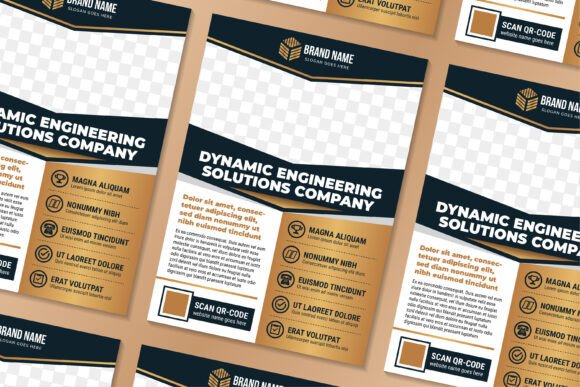
Dynamic Engineering Vertical Flyer: A Strategic Design Asset for Manufacturing
In the competitive landscape of industrial marketing, visual communication often dictates the first impression a potential client forms. For manufacturing and technology firms, the Dynamic Engineering Vertical Flyer represents more than just a template; it is a structured approach to presenting complex engineering solutions with clarity and authority. This specific design resource leverages a sophisticated aesthetic—combining black and gold elements with space-themed photo collages on a clean white background—to convey innovation, precision, and luxury. Understanding the utility of this format requires looking beyond the surface graphics to evaluate how it functions within a broader marketing strategy.
The Distinctive Aesthetic of the Dynamic Engineering Template
The primary differentiator of the Dynamic Engineering Vertical Flyer is its deliberate use of color psychology and spatial composition. The integration of black and gold creates an immediate association with premium quality and established reliability, traits that are essential for companies in the heavy industry or advanced technology sectors. Unlike generic templates that rely heavily on stock photography alone, this design utilizes a "space photo collage" concept. This abstract representation suggests vast possibilities, futuristic thinking, and the exploration of new frontiers—themes that resonate deeply with clients seeking renewable energy solutions, advanced robotics, or next-generation infrastructure.
Furthermore, the layout is engineered for versatility. The design balances dense informational areas with open white space, ensuring that technical specifications do not overwhelm the viewer. The inclusion of vector-based geometric shapes and arrows guides the reader's eye through the narrative, transforming a static page into a dynamic flow of information. This is particularly effective for brochures that need to explain complex ecosystems or electrical grids, where visual hierarchy is as important as the text itself.
Evaluating Format and Resolution: Vector vs. Raster
When comparing the Dynamic Engineering Vertical Flyer to standard digital assets, the technical specifications become a critical decision factor. Many online resources offer designs in raster formats (such as PNG or low-resolution JPG), which degrade when scaled up for large-format printing like banners or billboards. In contrast, this template is built entirely on 100% vector graphics. This distinction is vital for manufacturers who require materials at high resolutions, specifically 300dpi, for professional print runs.
The vector nature of the file means that every shape, line, and icon remains crisp regardless of the output size. Whether the design is adapted for a small business card or a massive vertical web banner for a factory entrance, the integrity of the geometry is preserved. Additionally, the editable nature of the text, shapes, and colors allows for rapid customization without the need to redraw elements. This flexibility contrasts sharply with static image files, where changing a single word might require pixel-level editing or complete reconstruction by a graphic designer.
Comparing Vertical Flyers to Alternative Formats
While the vertical orientation is a defining characteristic of this flyer, it is important to consider how it compares to horizontal layouts or other media types. Vertical flyers are traditionally favored for handheld distribution, trade show handouts, and direct mail. They align naturally with the way humans read and hold paper, making them ideal for detailed reading sessions where the recipient can engage with the content at their own pace. However, horizontal formats often perform better for desktop screens or wide-format signage where the aspect ratio matches the viewing environment.
The Dynamic Engineering Vertical Flyer addresses this by offering a robust structure that can be adapted. While the core design is vertical, the modular components—icons, gradients, and collage elements—are designed to be reorganized. This makes it a hybrid tool; it serves as a primary flyer but also provides the raw assets needed to create horizontal variations, social media posts, or even cover pages for larger reports. For businesses deciding between a dedicated vertical flyer and a multi-purpose kit, this template offers a middle ground, providing the specificity of a flyer with the adaptability of a comprehensive brand kit.
Strengths and Tradeoffs in Professional Application
The strengths of the Dynamic Engineering Vertical Flyer lie in its ability to communicate complexity with elegance. The combination of abstract business icons with realistic space imagery creates a unique visual language that separates the user from competitors relying on clichéd factory photos. The "black and gold" palette reinforces a sense of corporate stability, while the "green," "blue," and "electricity" gradient accents subtly nod to sustainability and power, addressing modern industry concerns regarding renewable energy and efficiency.
However, there are tradeoffs to consider. The highly stylized nature of the design, particularly the space collage and geometric overlays, may not suit every sub-sector of engineering. For example, a company focused on traditional civil construction or agricultural machinery might find the futuristic aesthetic slightly misaligned with their brand identity. In such cases, a cleaner, less abstract template might be more appropriate. Additionally, because the design relies heavily on specific color combinations (black, gold, white) to achieve its impact, brands with strict adherence to primary red or orange palettes may find the customization process more labor-intensive than starting with a neutral base.
Decision Factors: When to Choose This Resource
Selecting the right design asset depends on the specific goals of the marketing campaign. The Dynamic Engineering Vertical Flyer is the optimal choice for technology-driven manufacturing firms, engineering consultancies, and companies specializing in renewable energy or aerospace. It is particularly effective when the goal is to showcase innovation, future-proofing, and high-end technical capability. If your target audience consists of investors, government bodies, or enterprise clients who value precision and forward-thinking, this template's sophisticated layout will likely yield a higher engagement rate than simpler alternatives.
Conversely, if the objective is a quick, low-cost internal memo or a local service advertisement requiring minimal design time, a simpler, pre-filled template might suffice. The full potential of the Dynamic Engineering Vertical Flyer is realized when the user takes advantage of its editable layers to insert custom data, charts, and high-resolution product photography. It is best suited for organizations that have a clear message about their technological ecosystem and need a vehicle that reflects the seriousness and scale of their operations.
Technical Deliverables and Workflow Integration
From a practical workflow perspective, the inclusion of multiple file formats—AI, EPS, JPG, and SVG—ensures compatibility across various design software and production pipelines. Adobe Illustrator (AI) and Encapsulated PostScript (EPS) files allow designers to work directly with the source vectors, maintaining full control over the layout. Scalable Vector Graphics (SVG) are essential for web applications, ensuring that the design scales perfectly on responsive websites and digital banners. The provided JPG files serve as immediate previews or low-fidelity drafts for stakeholder approval.
This comprehensive package eliminates the friction often encountered when working with incomplete design assets. A well-organized file structure reduces the time spent searching for specific elements, allowing marketing teams to focus on content creation rather than technical troubleshooting. For professionals managing tight deadlines, having all necessary components—from the main layout to individual icons and gradients—available in a single download significantly streamlines the production process.
Conclusion: Aligning Design with Business Goals
The Dynamic Engineering Vertical Flyer stands out as a specialized tool for companies that need to project competence, innovation, and reliability. Its distinct blend of luxury aesthetics and functional layout offers a compelling alternative to generic templates, particularly for those in the technology and manufacturing sectors. By weighing the benefits of vector scalability against the specific stylistic needs of your brand, you can determine if this resource aligns with your strategic objectives. Ultimately, the value of this design lies not just in its visual appeal, but in its capacity to elevate the perception of your engineering solutions in a crowded marketplace.